Vittorio Arrigoni, fighter for peace
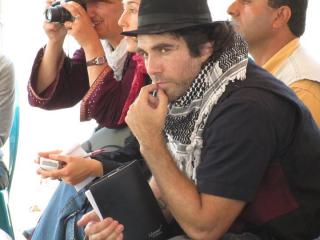
by Alberto Arce, (El País, April 15, 2011)
– translated from Spanish by Paul Lee
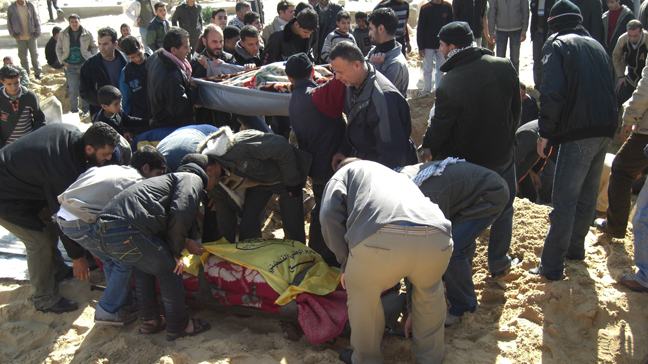
Vittorio Arrigoni, an Italian activist of the International Solidarity Movement, was killed yesterday evening in an abandoned house in the Gaza Strip, perhaps one of the houses that he helped to evacuate during the bombing of Operation Cast Lead.
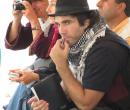
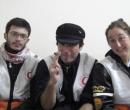
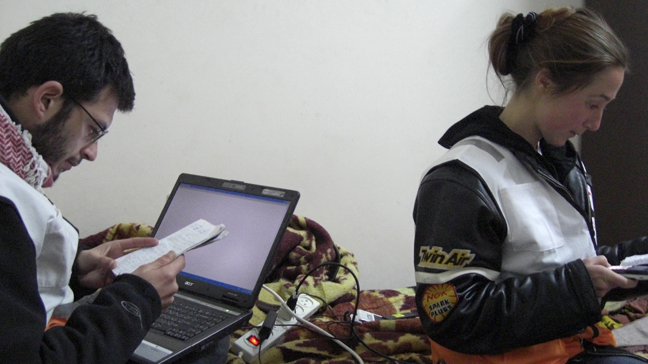
During the three weeks of that operation, Vittorio wearing a Palestinian paramedic vest, jumped several times a day inside an ambulance, and shouted to Marwan, our favorite driver who was busy dodging the bombs and white phosphorus lighting the way, “Yalla, Yalla, Schumacker, drive around faster than they expect us to.” “Vic Utopia” as we called him, was the first to get out of the vehicle, to remove the debris, to take pictures, to tend to the wounded, to support the families, to phone Italy to tell what happened, to share snuff with all who asked for it, and to voice his disapproval. Always voicing his disapproval, and loudly. Vittorio was always voicing his disapproval to what we were witnessing.
Vittorio was fearless. He never ducked when an explosion sounded nearby. Quite the contrary. He was screaming and yelling. Cursing those who were shooting at us, getting angry, looking around, and managing to encourage us all. With personality and character. Always with a pipe in his mouth, writing in his notebook, and talking on the phone. Vittorio did not engage in discussions, he reacted more as Palestinians would, acted as they would, turned himself into one of them. Vittorio was becoming more a Gazan. No need to speak Arabic, nor hardly any English. His language was Italian, and that was how he made himself understood with everyone, through smiling, bantering, and gesturing. Vittorio was committed to persistence. The integrity of someone who was willing to go to the end. With principles and convictions. Vittorio was not a seeker of thrills and adventures.
On the contrary. He was one of the most conscientious members of the International Solidarity Movement (ISM). A foreigner who has spent more time in the Gaza Strip, trying to assemble a stable group of activists who participated in the Palestinians’ non-violent resistance against the occupation. When the Israeli army killed Rachel Corrie and Tom Hurndall in 2003, ISM decided to withdraw from the area, to avoid further deaths. At that time Vittorio was involved in organizing activities in the West Bank. Eventually all ISM members there were arrested and deported by the Israeli authorities. Vittorio was not spared.
He then got involved with rallying together part of the original core team of the Free Gaza movement, to break the Israeli naval blockade by sending ships that carried journalists and activists, sailing from Cyprus to the besieged Gaza Strip. In August 2008 he was part of the maiden voyage, sailing in the first foreign ship to dock in Gaza since 1967. Once there, Vittorio and half a dozen others began to establish contacts, so that the foreign contingent of the ISM could engage in, alongside the Palestinians, non-violent resistance actions against the Israeli army. Vittorio and his team went out every morning to fish with the fishermen. They offered their presence and their passports as human shields, to prevent the Israeli patrol boats from shooting at the fishermen. They taped the attacks, and told the world about these attacks.
Vittorio was arrested by the army. He was shot with a stun gun. He fell to the sea, and almost drowned. After several days in an Israeli prison he was deported to Italy. Two weeks later he returned to Gaza. He never threw in the towel. I met him hours before boarding, together, in the last boat that reached port. It was the boat that arrived in Gaza on December 19, 2008, bringing the seven foreigners who lived through Operation Cast Lead. He spent the night explaining to me what the international brigades of the war in Spain meant to him. He was impassioned. Vittorio felt that his presence in Gaza was that of a brigadier. Orwell and Homage to Catalonia were his reference points.
When the bombings began on Gaza, it was Vittorio who proposed that we offered ourselves as volunteers to drive around with the ambulances. It was he who convinced us, and negotiated with the Red Crescent, that the seven of us foreigners who were at that time in the Gaza ISM group, to become first-line witnesses of what was happening there.
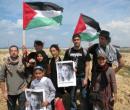
When the war ended, and Israel declared a ban on travel on land adjacent to the border – land that is the most fertile in Gaza, and land on which thousands of farmers depend, Vittorio once again led the group of foreign volunteers to offer their fluorescent vests and cameras as human shields, so that families could have access to harvest their crops. They were shot at, he recorded this, and told the world. Without fear. With conviction. That was his work. Less than a week later, when Israel bombed Gaza again, He sat down to smoke nargile with one of the staff running the Palestinian Centre for Human Rights, and recorded, together, their latest video, wondering, as always, how all that could be stopped. Vittorio was among those who stayed when the news broadcast ended. Among those who thought that to stay would be synonymous with “forever. “
Vittorio did not like the word cooperative. His work was not humanitarian. His work was political. He also rejected the notions of equidistance and neutrality. Vittorio was a fighter for peace. For a just peace.
Vittorio spoke to us every day about old Italian partisans. He sang us his songs in Italian. “If my grandparents fought in the past century against fascism, we are fighting now against occupation. But without Mauser. With weapons of solidarity, with journalism and words.” Vittorio was still very much a convinced communist. He tattooed the word “mukawarma”, “resistance” in Arabic, on his right forearm.
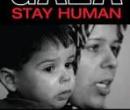
He wrote from Gaza a series of chronicles for Il Manifesto during the hellish weeks of Operation Cast Lead. These chronicles were later turned into a book, and were translated into various languages. His preface, “Guernika in Gaza” begins with: “From Israel comes a terrible threat: this is only the first day of a bombing campaign that could last for two weeks. They will create a desert, and call it peace. The silence of the world is now much more deafening than the explosions that cover the city like a shroud of terror and death. We are and continue to be human beings.”
Vittorio died just days after Juliano Mer-Khamis. Killed by fanatical fundamentalists opposed to peace. Juliano and Vittorio were the best. They belonged to that group that Israeli writer and activist Michael Warsavsky locates “on the other side of the border,” away from any nationalities and religions, united by a common belief. In solidarity. And humanity.